NextEra Energy and Dominion Energy Agree to Combine in Record $66.8 Billion Bet on Data Center Power Demand
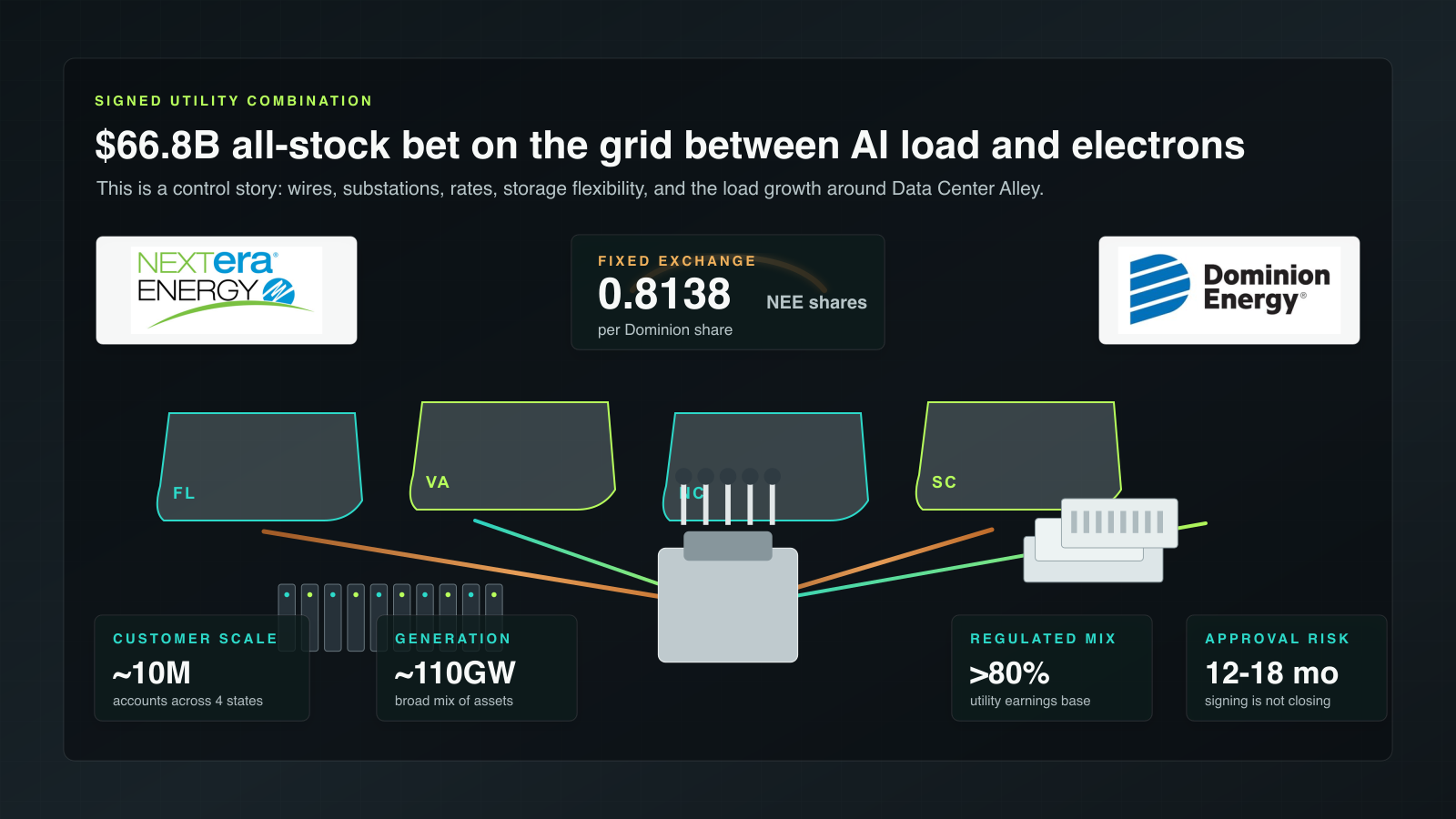
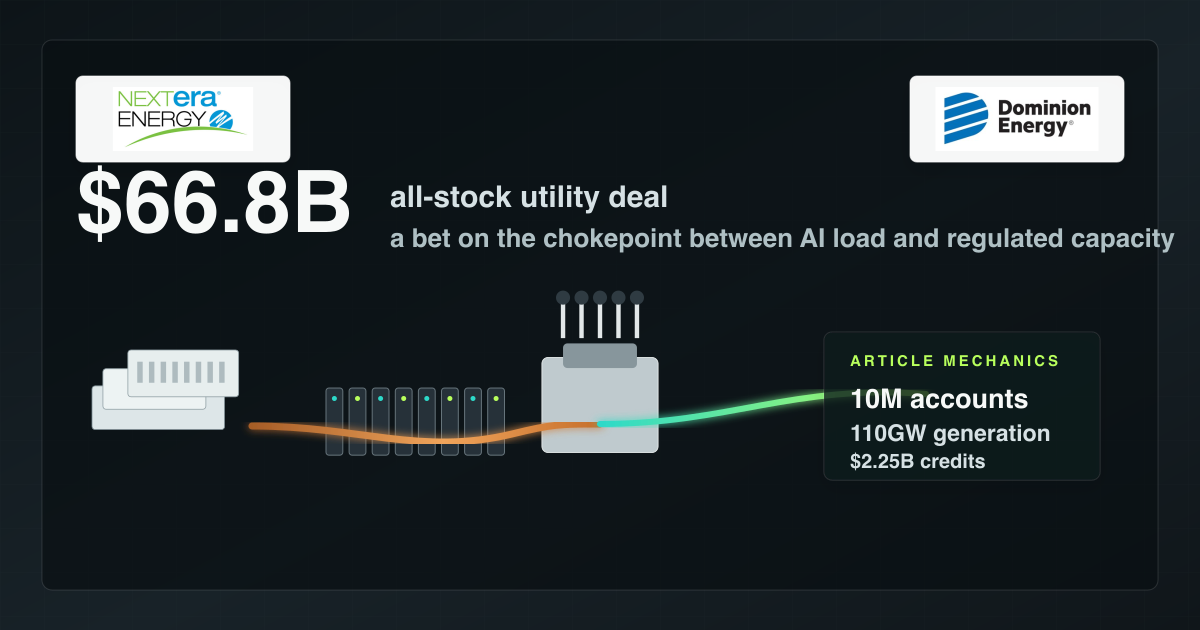
NextEra Energy and Dominion Energy agreed on May 18 to combine in an all-stock transaction valued at about $66.8 billion, the largest acquisition of a power utility on record. The companies describe the result as the world’s largest regulated electric utility business. Stripped of the language, the deal is a direct wager that artificial intelligence and data center growth will drive American electricity demand for a decade.
Under the agreement, Dominion shareholders receive a fixed 0.8138 NextEra share for each Dominion share they hold. NextEra shareholders would own about 74.5 percent of the combined company and Dominion shareholders about 25.5 percent. The merged utility would serve roughly 10 million customer accounts across Florida, Virginia, North Carolina, and South Carolina, own about 110 gigawatts of generation across a broad mix of sources, and run more than 80 percent regulated. John Ketchum, NextEra’s chief executive, would lead it.
The two companies. NextEra, based in Florida, serves about 6 million customers through Florida Power and Light and operates the largest fleet of wind, solar, and battery storage in the United States through its NextEra Energy Resources arm. Dominion serves about 4 million customers across Virginia, North Carolina, and South Carolina. The two utilities have almost no overlapping service territory.
Data Center Alley. The logic of the deal sits in Loudoun County, Virginia. Dominion’s territory includes the world’s densest concentration of data centers, the cluster known as Data Center Alley, and the combination places the merged company inside PJM Interconnection, the largest electricity market in the country. PJM has forecast peak summer demand growing more than 5 percent per year over the next decade, a rate the grid has not seen in a generation. Ketchum has described the moment as “America’s golden age of power demand.”
For an energy storage industry that has spent two years arguing that load growth would force the grid to buy flexibility, the deal reads as confirmation. NextEra is the largest developer of battery storage in the country. Dominion sits in the grid with the steepest projected load curve. The combination places both on the same balance sheet, pairing the company best positioned to build storage with the territory that will need the most capacity fastest.
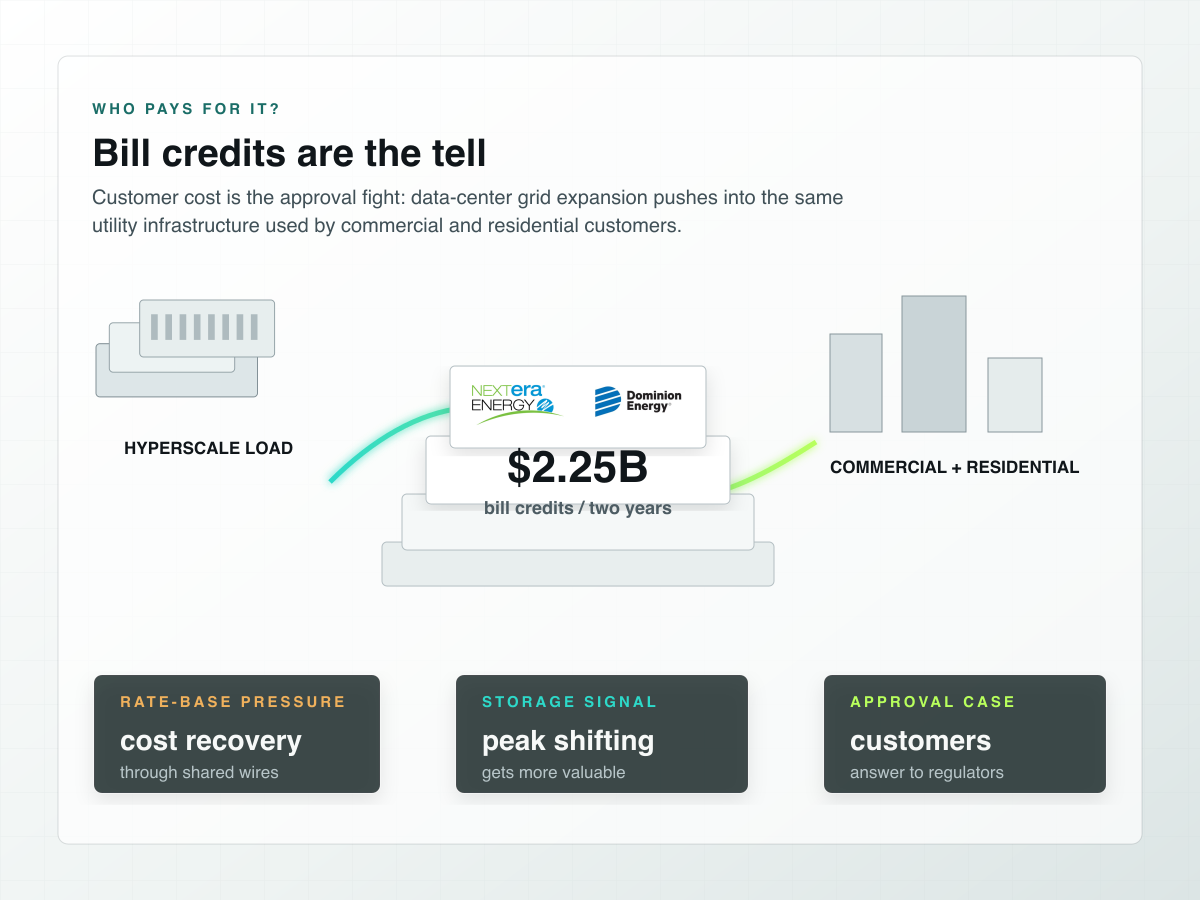
Who pays for it. The harder question is how the cost lands. Regulated utilities earn returns by building assets and recovering the cost from ratepayers. A $66.8 billion bet on data center growth is, in practice, a bet that regulators will allow the combined company to expand its rate base to serve hyperscale customers, with the cost of new transmission and generation spread across customer classes. The companies appear to know it. The agreement includes $2.25 billion in electric bill credits for Dominion customers in Virginia, North Carolina, and South Carolina, spread over two years. A concession of that size, announced alongside the deal rather than extracted later by a regulator, is a tell: the combined company expects the central approval question to be customer cost, and it is pre-paying part of the answer. Commercial and residential customers in Virginia do not operate data centers, but they share the wires.
That dynamic gives the deal a quieter implication for behind-the-meter storage. Where capacity is scarce and delivery costs are rising, the value of shifting load off the peak rises with it. PJM’s capacity prices have already climbed sharply. A utility merger does not change that math. It concentrates the entity setting the rates around it.
NextEra’s record on deals this size. NextEra brings a specific history to a transaction of this scale. In 2016, Hawaii’s Public Utilities Commission rejected its $4.3 billion acquisition of Hawaiian Electric as not in the public interest. In 2017, the Public Utility Commission of Texas twice rejected its $18 billion bid for Oncor, citing ratepayer risk and a dispute over “ring-fencing” provisions meant to wall off the utility’s finances from its parent. The company’s leadership argued at the time that it could not pay $18.7 billion for a utility it could not fully control. The Dominion combination requires approval from utility commissions in Virginia, North Carolina, and South Carolina, the Federal Energy Regulatory Commission, and shareholders of both companies. The companies hope to close within 12 to 18 months, in a political environment far more sensitive to electricity prices than it was a decade ago.
A run of consolidation. The deal caps a striking stretch of dealmaking. In March, Global Infrastructure Partners and EQT agreed to take AES private for $33.4 billion. BlackRock has agreed to acquire Aligned Data Centers for $40 billion. Blackstone is buying TXNM Energy for $11.5 billion. Capital is moving toward whoever controls the connection between AI compute and the grid, and it is moving in tens of billions at a time.
The deal is now signed, but signing is not closing. NextEra’s own history shows the distance between the two can be considerable, and a transaction this large will spend a year or more in front of regulators who answer to electricity customers. What the agreement settles is the premise. The most contested position in American power is no longer generation or retail supply. It is ownership of the grid that stands between the data centers and the electrons they consume.
Sources
- NextEra Energy and Dominion Energy to Combine (NextEra Energy newsroom)
- NextEra, Dominion announce merger to create U.S. power behemoth (Axios)
- NextEra will buy Dominion in a $66.8 billion power deal amid the AI boom (NBC News)
- NextEra Energy to buy Dominion in $66.8 billion US power deal (Reuters via Investing.com)
- Texas regulators reject $18B NextEra-Oncor deal (Utility Dive)
- NextEra, Hawaiian Electric terminate merger after PUC rejection (Utility Dive)